
IBISWorld Platform
Answer any industry question in minutes with our entire database at your fingertips.

Over the five years through 2026-27, the CPI increased at a compound annual rate of 4.7% to reach 142.4 points. Price inflation is a measure of the annual percentage change in the cost of living, represented by the CPI the UK government's preferred measure, covering services, housing, utilities, food and transportation.The CPI inflated by a comparatively slow 0.6% year-on-year in 2020-21, suppressed by demand destruction from worker furloughing, the collapse in global oil prices and government stimulus schemes that lowered prices for consumers. In 2021-22, annual growth in the CPI accelerated by 4% as the economy reopened and supply constraints caused prices to surge. In 2022-23, inflationary pressures intensified sharply, the UK 12-month CPI rate hit a high point of 11.1% in October 2022, driven primarily by energy price volatility and supply chain disruption stemming from the Russia-Ukraine conflict.In response, the BoE's Monetary Policy Committee (MPC) systematically raised the Bank Rate from its pandemic low of 0.1%, reaching a peak of 5.25% in August 2023. Higher borrowing costs discouraged consumer spending and business investment, exerting downward pressure on prices across housing, retail and services. In 2023-24, CPI growth moderated as this tightening cycle took hold. Inflation continued to cool in 2024-25. As price pressures subsided, the BoE shifted stance, cutting the Bank Rate from 5.25% to 5.0% in August 2024, to 4.75% in November 2024 and to 4.5% in February 2025.In 2025-26, energy and water price increases at the start of the period, alongside national insurance and minimum wage hikes, drove CPI higher, with the annual rate reaching 3.8% in September 2025. However, inflation has since trended lower. The BoE continued easing policy throughout this period, reducing the Bank Rate to 3.75% by December 2025, before holding at that level at its February 2026 meeting, with the MPC noting it now expects inflation to return to the 2% target by spring 2026.
Curious about what drives these trends? IBISWorld's analyst coverage on the consumer price index includes detailled analysis on the current performance, outlook and industries affected.
2001-2033
The consumer price index (CPI) measures change in the average price of consumer goods and services – specifically, the ONS defines it as "a measure of consumer price inflation - the rate at which the prices of goods and services bought by households rise or fall - produced to international standards and in line with European regulations. The CPI is the inflation measure used in the government's target for inflation". The CPI is weighted based on the value of each good and service purchased by consumers.Historical time series data is sourced from the Office for National Statistics (ONS). Forecast data is produced by IBISWorld, with reference to estimated values produced by the Office for Budget Responsibility (OBR), in its "Economic and fiscal outlook – March 2022" publication, and the those formulated by the Bank of England (BoE), as per its "Monetary Policy Report – May 2022" statement. Annual figures represent the average monthly value of the CPI over each financial year (i.e., April-March), with base year calendar year 2015 - that is, the average price of the 2015 calendar year equals 100. The Bank of England (BoE) has a remit, set by government, of manipulating monetary policy to guide and maintain CPI to a target of 2%, with a margin of plus-minus 1.0 percentage point.
IBISWorld Industry Reports are available in multiple formats to fit seamlessly into your workflow.
Answer any industry question in minutes with our entire database at your fingertips.
Feed trusted, human-driven industry intelligence straight into your platform.
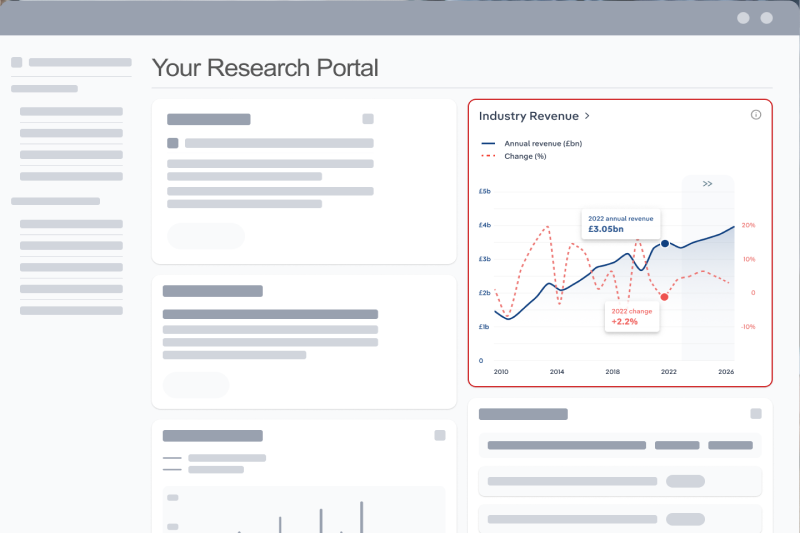
Streamline your workflow with IBISWorld’s intelligence built into your toolkit.
Explore industries with similar markets, supply chains, and economic drivers to gain broader context and insights.
| Industry | Country | Last 5-yr CAGR | Forecast 5-year CAGR | Revenue |
|---|---|---|---|---|
| Gas Distribution in the UK |
|
XX% | XX% | $XX |
When the stakes are high, you need intelligence that cuts through the noise—wherever you work.
The consumer price index in the UK in 2027 was 142.4 index points.
The consumer price index in the UK grew by 4.69% in 2027.
IBISWorld’s data and analysis on consumer price index in the UK includes forecasted growth rates over the next five years.